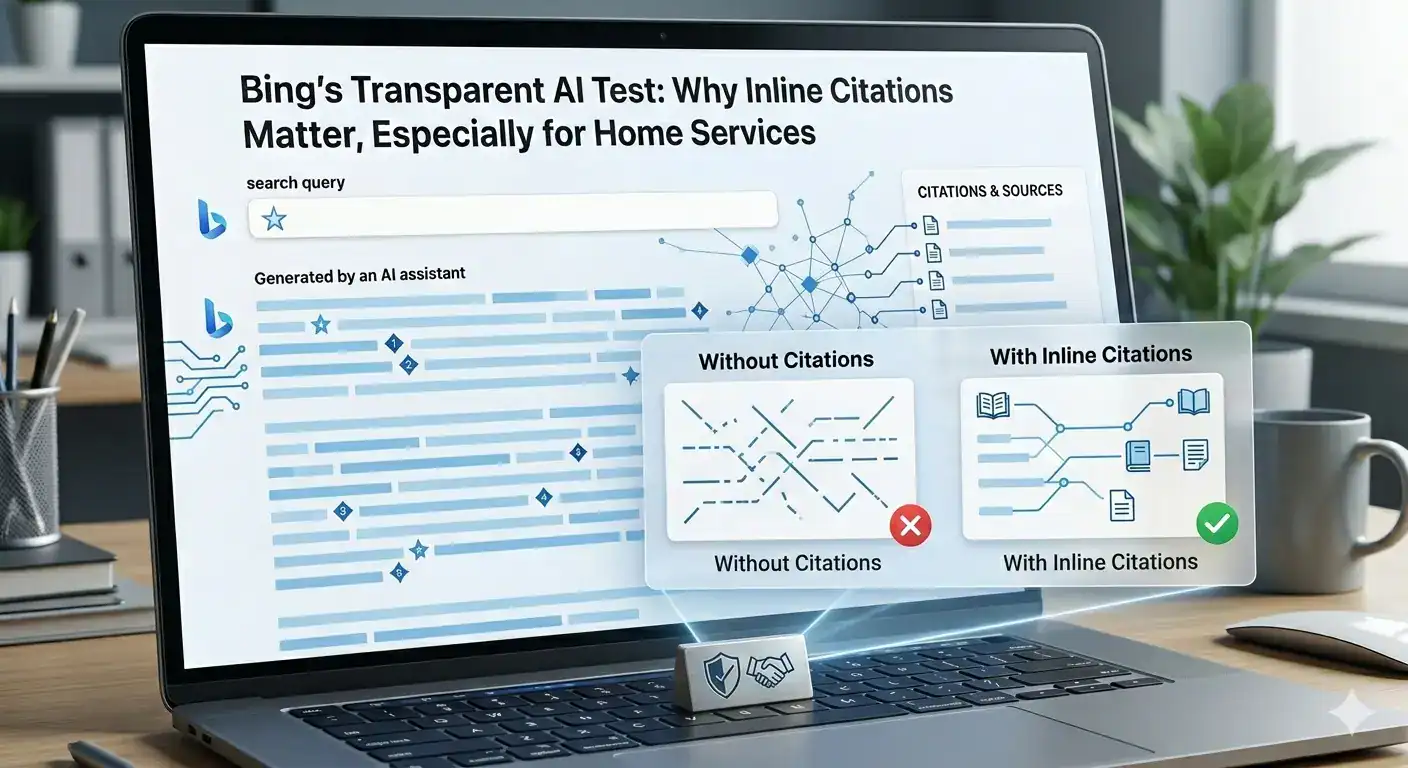

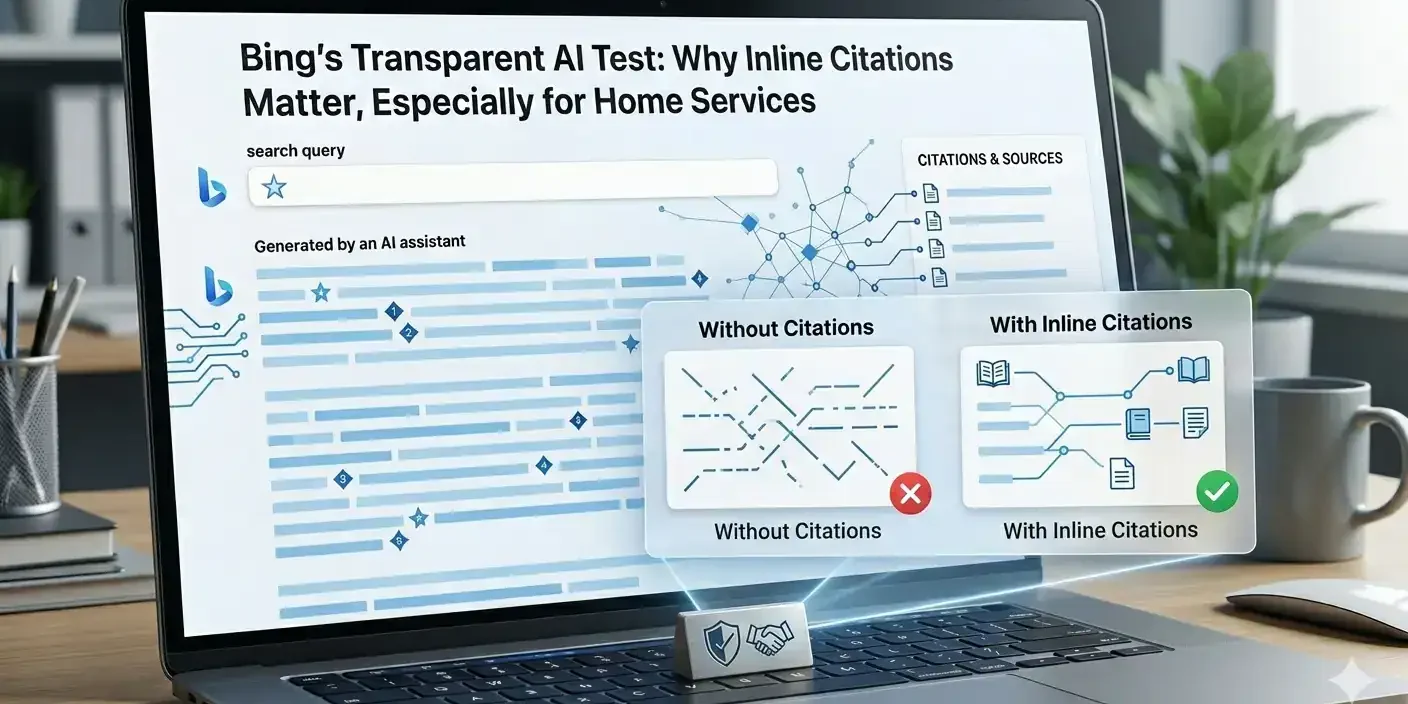
Bing’s Transparent AI Test: Why Inline Citations Matter, Especially for Home Services

5 min read
Share
In the middle of constant AI headlines and algorithm updates, it is easy to overlook smaller interface changes. However, some of the most meaningful shifts in technology happen at the design level. Microsoft is currently testing a redesigned Bing Copilot experience centered on one key principle: transparency.
This test introduces transparent inline citations and visual sidecards. While these may appear to be simple layout updates, they represent a larger shift in how AI presents information and how users evaluate credibility.
For industries built on trust, especially home services, this change could have serious implications.
What Microsoft Is Testing
Microsoft is experimenting with a Bing Copilot interface that includes:
- Inline links embedded directly within AI-generated responses
- Sidecards that display source references alongside the main text
The goal is to create richer AI result transparency. Instead of delivering a standalone answer, the system visibly connects claims to sources.
This means that when AI provides information, users can immediately see where that information originated without leaving the interface.
Inline Citations: Showing the Source Inside the Answer
Inline citations embed references directly within the AI’s response. Rather than placing links at the bottom of a page, citations appear next to the specific statements they support.
For example, if the AI explains how long a water heater typically lasts, the claim may include a visible link to the source that supports it.
This approach mirrors academic and journalistic standards, where statements are backed by visible references. It reduces ambiguity and strengthens credibility.
Sidecards: Verification Without Leaving the Page
Sidecards appear alongside the main AI response. These visual panels typically include:
- The source title
- The website name
- A brief content preview
- Publication details
Instead of forcing users to open multiple tabs to verify information, the sidecard displays supporting evidence immediately.
This reduces friction in the research process. Users can confirm accuracy quickly and continue reading without interrupting their workflow.
Why Transparency Matters More Than Ever
AI tools are often criticized for operating like black boxes. Users ask a question, and a polished answer appears without clear insight into how it was formed.
Inline citations and sidecards attempt to address that issue. By visibly attaching claims to sources, the AI makes its reasoning more traceable.
This shift moves AI from “trust me” to “check me.”
For low-stakes questions, this may feel unnecessary. However, for high-stakes decisions, transparency becomes essential.
And for home services businesses, this is where the impact becomes significant.
Why This Is Important for Home Services
Home services companies operate in a trust-driven environment. When a homeowner searches for:
- “How much does HVAC replacement cost?”
- “Signs I need a new roof.”
- “Is a leaking water heater dangerous?”
They often make urgent, expensive decisions.
If Bing’s AI begins providing answers supported by visible citations, the sources attached to those answers become critical.
1. Authority Will Matter More
If AI responses include sidecards from established industry publications, government resources, or trusted contractors, those sources gain visibility and credibility.
For home services companies, this means publishing high-quality, educational content becomes more valuable. If your website or brand is cited directly within AI responses, you benefit from built-in authority.
Instead of competing only for blue links in traditional search, you are now competing to be cited inside AI-generated answers.
2. Content Quality Becomes a Visibility Factor
If AI systems prioritize well-structured, informative, and trustworthy content, businesses with thin or promotional-only websites may struggle to appear in citations.
Home services companies that invest in:
- Detailed service guides
- Transparent pricing explanations
- Maintenance education
- Safety information
Increase their chances of being referenced by AI tools.
This moves content strategy from pure SEO tactics to credibility-driven publishing.
3. Trust Signals Influence Conversion
Homeowners rarely make hiring decisions casually. They look for reassurance.
If an AI response includes a sidecard citing a local contractor’s educational article, that visibility can function as a trust accelerator. The homeowner sees both the answer and the source simultaneously.
Even if the user does not click the citation, seeing a recognizable brand name next to a helpful answer builds familiarity.
In industries where reputation drives revenue, that visibility is powerful.
4. Reduced Friction Speeds Decision-Making
Sidecards reduce verification friction. Instead of navigating multiple websites, homeowners can confirm information within the AI interface.
This streamlined experience may shorten the research cycle.
For home services businesses, that means the company positioned as the trusted source could capture attention earlier in the decision process.
If your brand appears inside AI citations, you may influence the decision before the homeowner even begins comparing competitors.
The Competitive Shift in AI Search
Reports suggest that this Bing experiment contrasts with Google’s recent AI updates. While some AI interfaces prioritize seamless answers, Microsoft’s approach emphasizes visible sourcing.
This difference represents two competing philosophies:
- Seamless convenience
- Structured transparency
If transparency becomes the standard, industries built on trust will benefit from it the most.
Home services fall squarely into that category.
When repairs involve safety, cost, and long-term property value, homeowners want proof. AI systems that show their work may become the preferred option for serious research.
The Risk of Visual Overload
Transparency is valuable, but it also increases visual density. Inline citations and sidecards add more elements to the screen.
Some users may appreciate the detail. Others may find it distracting.
That is why this feature remains in testing. Microsoft is likely measuring whether users engage with citations or ignore them.
If users interact positively with the sidecards, transparency may become a permanent feature.
If engagement is low, simplicity may win.
What Home Services Companies Should Do Now
Regardless of the final outcome, this test signals a direction.
Home services businesses should:
- Invest in authoritative educational content
- Cite reputable sources within their own articles
- Structure content clearly for AI interpretation
- Focus on answering real homeowner questions
AI tools increasingly rely on trustworthy, structured information. Companies that provide clear, well-researched guidance position themselves to be cited.
The goal is no longer just ranking. It is becoming reference-worthy.
Final Takeaway
Microsoft’s experiment with inline citations and sidecards reflects a broader shift in AI search: transparency is becoming central to trust.
For home services companies, this shift matters deeply. Homeowners make high-stakes decisions, and they seek reassurance before spending thousands of dollars.
If AI interfaces highlight sources directly within answers, only credible and informative businesses will benefit.
The future of AI search may not be defined solely by speed or fluency. It may be defined by visible proof.
For industries built on trust, that is not just a design update. It is a competitive opportunity.
Follow Us
Belle G. – Tech Researcher, Daily News
Stay Informed. Stay Ahead.
Subscribe to our newsletter to receive industry insights, strategic updates, and expert perspectives—curated to support your business growth.